If you’re a DTG printer owner, you know how much the right ink can make or break your prints. I’ve been supplying DTG inks for almost a decade now, and I still get questions every day from folks who are overwhelmed by all the options out there. It’s not just about grabbing the cheapest bottle or the one that matches your printer’s brand name—there’s a lot more to it if you want crisp, long-lasting prints that won’t crack, fade, or clog your machine. Let me break this down like I would to a regular customer stopping by my shop, no confusing jargon, just real stuff that works. DTG Ink
First things first: before you even start browsing inks, pull up your printer’s manual. I can’t tell you how many times I’ve had a customer come to me with a random ink that’s gunked up their printhead because it’s not compatible with their specific model. Some printers are proprietary—they only play nice with inks from the same brand, and using third-party stuff will void your warranty or cause permanent damage. But wait, that doesn’t mean you’re stuck paying twice as much for brand-name inks. A lot of modern DTG printers work with compatible inks, but you have to check two key details: the ink type and the color set.
Speaking of ink type, most of what we supply is water-based DTG ink, right? That’s the standard for direct-to-garment printing because it’s designed to sink into cotton fibers instead of sitting on top. There are also discharge inks, which are a little different—they remove dye from dark fabrics so you can get bright, true colors without a heavy hand. If you’re only printing on light-colored tees, basic water-based ink is usually fine. But if you’re doing a lot of dark shirts, you’ll want discharge or a opaque white ink that’s thick enough to cover dark fabric without going see-through. A lot of new printers struggle with white ink, too—so you’ll need an ink that’s formulated to not separate easily, because if white ink clogs your printhead, that’s a huge, expensive mess.
Next up: color gamut. That just means how many colors an ink can produce. If you’re printing simple logos or designs with a small color palette, a 4-color set (cyan, magenta, yellow, black, plus white for darks) will work. But if you’re doing photo-realistic prints, gradient-heavy art, or custom designs that need super bright blues or reds, you’ll want a 6-color or even 8-color set. Adding light cyan and light magenta, for example, softens gradients so they don’t look grainy, which is a game-changer for portraits or detailed artwork. I see a lot of beginners skip this and end up redoing prints because the colors look dull or washed out. It’s worth spending a little extra for a wider gamut if that’s the kind of work you’re doing.
Then there’s durability and wash resistance. Let’s be real—no one wants a print that fades after 2 washes or cracks the first time it’s dried. Good DTG inks have binders that bond to the fabric fibers, so they stay flexible even after multiple washes. I test every batch of inks we supply by doing 10+ wash cycles on the same shirt, and I don’t sell anything that shows fading or cracking after that. Some cheaper inks skip on the binders to cut costs, but those end up costing you more in the long run because you’ll have to reprint orders. If you’re doing commercial work, like for a brand or event, this is non-negotiable. Customers will notice if your print peels off, and word travels fast in the apparel space.
Another big one: printhead compatibility. Every printhead (whether it’s Epson, Ricoh, or whatever your printer uses) has specific needs for ink viscosity, pH levels, and particle size. For example, Epson printheads are really sensitive to large particles in ink, so you need an ink that’s filtered to a tiny micron size—like 0.2 microns—to avoid clogs. Ricoh printheads, on the other hand, handle a little thicker ink, so you don’t have to worry as much about small particles, but you still need the right pH to keep the printhead from corroding. If you mix up ink for your printhead, you’ll be replacing it every few months, which can cost hundreds of dollars. Always ask your ink supplier what’s recommended for your specific printhead model—good suppliers will tell you, not just try to sell you any ink.
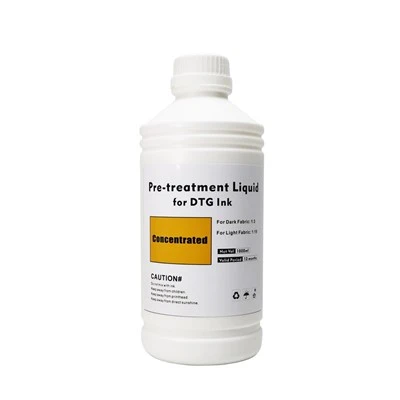
Wait, what about pre-treatment ink? Oh right, a lot of people forget that your DTG ink pairs with pre-treatment, and you should pick both from the same line. If you buy a random white ink and a cheap pre-treatment from somewhere else, they might not mix well. I’ve had customers say their white ink turns yellow after a few washes, and 9 times out of 10 it’s because the pre-treatment and ink are incompatible. Stick to a single brand or line for both, or at least confirm with your supplier that the two play nice. That’s a small detail that saves so many headaches.
Budget is obviously a factor, but don’t let it be the only one. A 1L bottle of ink that’s $50 might seem like a steal, but if it clogs your printhead or ruins a batch of custom orders, that’s way more than the cost of a $70 bottle of reliable ink. I always tell customers: calculate the cost per print. A good ink might cost a bit more upfront, but it lets you print more jobs without issues, and you won’t have to waste ink on bad prints. For high-volume printers, that adds up to thousands in savings every year. If you’re a small home-based printer just starting out, you can go with a mid-range compatible ink to keep costs down, but still test a small bottle first before buying a case.
Also, ask about lightfastness. If you’re printing designs that will be displayed outside, like for a trade show or outdoor event, you need inks that are fade-resistant to sunlight. Some inks are formulated with UV inhibitors, which makes them last longer when exposed to the sun. Regular water-based inks might fade within a few months if left outside, so that’s a key point for anyone doing outdoor work. I always recommend checking if the inks we supply have been tested for lightfastness—we provide that info for every batch, so you don’t have to guess.
Let’s talk about red flags to avoid. If an ink supplier won’t tell you what’s in their inks, walk away. Good suppliers will list ingredients: binders, pigments, additives, filtration specs. If they just say “it’s DTG ink” and can’t give you details on particle size or pH, that’s a red flag. Also, if they offer super cheap ink but no tech support. If something goes wrong with your printer or ink, you need someone to help you troubleshoot, not just a vendor who doesn’t answer your calls. That’s why I always make time to walk customers through any issues, even if they bought a small bottle from me.
Another thing: test before you commit. Almost every supplier, including us, will give you a small sample bottle to test in your printer. Don’t skip this step! Run a test print on a few different fabrics, do a wash test, check for clogs in your printhead. A sample is free, so there’s no reason not to. I’ve had customers come to me after buying a case of ink that didn’t work in their printer, and it’s such a fixable mistake if they’d just tested first.
Wait, what about specialty inks? If you’re into custom work, like glitter inks, neon inks, or textured inks, those are fun, but they come with their own considerations. Glitter inks have larger particles, so they might clog fine printheads, and neon inks are often less lightfast than regular colors. If you’re doing specialty prints, make sure the ink is formulated for your printer, and be prepared to clean your printhead more often if needed. It’s not that they’re bad, they just have different needs than standard inks.
Let me wrap this up with a quick recap to make sure you don’t miss anything. First, check your printer’s compatibility manual—no exceptions. Second, pick an ink type that matches your fabric (light vs dark) and your needs (simple designs vs photo prints). Third, confirm durability and wash resistance, especially if you’re doing commercial work. Fourth, match ink to your printhead’s specs to avoid costly damage. Fifth, stick with a supplier that tells you about their ink’s ingredients and offers support. And always test a sample before buying in bulk.
If you’re still not sure which ink is right for your setup, hit me up to chat through your specific printer, the kind of fabrics you print on, and the projects you’re working on. No pressure, just honest advice that’s worked for hundreds of my customers over the years. Don’t waste time and money on the wrong ink—let’s find the one that works for you.
DTF References
- “Direct-to-Garment Ink Compatibility & Printhead Care,” Textile Print Journal, 2022.
- “Color Gamut Optimization for DTG Printing,” Apparel Manufacturing Technology Report, 2021.
- “Wash Resistance Testing for Water-Based DTG Inks,” International Textile and Apparel Association, 2020.
- “Ink Viscosity and Micron Size: Impact on DTG Printhead Performance,” Printer Technology Review, 2023.
- “Lightfastness Standards for Outdoor DTG Prints,” Outdoor Apparel Trade Journal, 2022.
Shenzhen Kyeink Technology Co., Ltd.
We are one of the most experienced dtg ink manufacturers and suppliers in China, featured by quality products and good service. Please rest assured to wholesale high-grade dtg ink at competitive price from our factory. Contact us for more details.
Address: #72, Songgang Rd, Bao’an, Shenzhen, China
E-mail: yoyo@kyeink.com
WebSite: https://www.kye-ink.com/
