If you’re in the market for water that’s basically stripped of almost all charged impurities, you’ve probably heard the terms electrodeionization (EDI) and deionized water (DI) thrown around. As a DI water system supplier, I get tons of questions about when to pick one over the other—so let’s break this down without the stuffy jargon. First, a quick side note: I’m not here to sell you anything in a pushy way, just to clear up the confusion that’s super common for folks who don’t work with these systems every day. Deionized Water System

Let’s start with the old-school DI most people know. Traditional DI systems rely on ion exchange resins, right? Those little plastic beads that grab onto charged particles like minerals, salts, and metals from water. You load the beads into tanks, and as water flows through, they swap their own hydrogen or hydroxide ions for the bad stuff in the water. The catch? Those resins get used up over time. Once they’re full of impurities, you can’t just keep going—you have to regenerate them with strong acids and bases, which is a messy, labor-intensive process. If you skip regeneration, your water quality drops fast. Plus, you have to shut the system down to do it, which is a huge headache for operations that run 24/7, like pharma labs, electronics manufacturing, or food and beverage processing. I’ve heard from clients who’ve had production delays because their DI system went down mid-run—total nightmare.
Now, EDI is the newer kid on the block. Instead of those ion exchange beads that need manual regenerating, EDI uses a mix of ion exchange resins, electric fields, and permeable membranes. Here’s how it works: you feed the raw water into a stack of EDI cells, each with positive and negative electrodes (that’s where the “electrode” part comes in). The electric field pulls the charged impurities through the membranes, so they get stuck in a separate stream that you flush away. The resins in the cells make this pulling way more efficient by filling in gaps where the membranes don’t catch all the ions. The best part? No messy acid or base regeneration. You just run the system, and it keeps producing consistent high-purity water without the downtime. For clients that need a steady flow—like semiconductor fabs that can’t afford even a tiny blip in water quality for cleaning wafers—EDI is a game-changer.
Wait, so what’s the real difference when it comes to water quality? Both systems can get you to that super pure “ultra-pure water” (UPW) level, but EDI tends to have tighter, more consistent purity. Traditional DI can sometimes have resin “breakthrough” if you forget to regenerate on schedule—meaning tiny bits of impurities sneak back into your water. EDI eliminates that because it’s a continuous process, not a batch one. That consistency is huge for industries where even a single microgram of contamination can ruin a product, like biotech where injectable drugs are made, or electronics where a single particle can short-circuit a chip.
Cost is another big one, especially if you’re looking at long-term use. Traditional DI systems have lower upfront costs—you can get a basic DI unit for a few thousand bucks, whereas EDI systems are pricier upfront. But let’s do the math: traditional DI has recurring costs for regeneration chemicals, labor to change out or regenerate resins, and downtime. I’ve had a semiconductor client who used traditional DI and spent almost $10k a year on acid and labor for regeneration, plus two days of downtime a month. When they switched to EDI, their annual costs dropped by 60% because no more chemicals, no more labor for regeneration, and zero downtime. EDI also uses less water overall—only about 5-10% of the feed water gets flushed away as waste, vs. traditional DI which can waste up to 50% during regeneration. That’s a big deal for companies that have strict water usage rules or high utility bills.
But hold on—EDI isn’t always the right call. If you’re a small business, like a small lab or a local car wash that needs occasional DI water for cleaning parts, the upfront cost of EDI might not make sense. Traditional DI is simpler to operate for small volumes—you just change the resin cartridges every few months, no fancy setup needed. EDI also requires a bit more technical know-how to maintain; if you’re not used to running electrical systems, you might end up paying for service calls that eat into those savings. And if your feed water is super dirty, like has a lot of suspended solids, you’ll need extra pre-filtration for EDI to keep the membranes and electrodes from clogging. Traditional DI is more forgiving here—resins can handle a little more gunk before they need regeneration.
Another thing to note: waste. Traditional DI regeneration produces chemical waste—strong acids and bases that have to be disposed of properly, which adds to your costs and is not great for the environment. EDI’s waste is just a small stream of concentrated impurities, no harsh chemicals, so it’s way easier to dispose of. For companies that are focused on sustainability, that’s a big selling point. I’ve had a few clients in the food industry switch to EDI because they needed to meet green initiatives and cut back on chemical waste from their old DI systems.
Let me throw in a quick example to make this real. A few years back, I worked with a mid-sized pharmaceutical company that made sterile saline solutions. They were using traditional DI, and every time they regenerated the resins, they had to shut down their production line for 8 hours. That meant they had to pay overtime to workers and lost revenue from not making product. When they upgraded to EDI, they didn’t just fix the downtime issue—they also saw their water purity go up, which cut down on failed batches from contamination. The upfront cost was higher, but they paid it back in less than a year from reduced labor and chemical costs alone.
So, to wrap this up: traditional DI is cheap upfront, simple for small volumes, but high on long-term costs, downtime, and chemical waste. EDI is pricier up front, but better for continuous operations, has consistent quality, lower long-term costs, and is more eco-friendly. The right pick depends on your specific needs—how much water you use, how consistent your quality needs to be, your budget, and how much technical support you have.
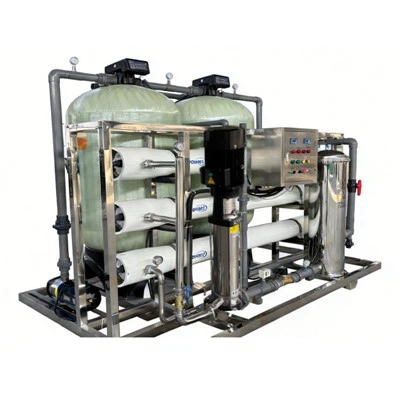
If you’re still not sure which one fits your operation, don’t overthink it. I’ve helped hundreds of clients figure this out—all you need to do is share a few details like your daily water demand, your feed water quality, and what you use the pure water for. We can walk through the pros and cons without any pressure to buy anything immediately. Just reach out, and we can chat through what makes sense for you.
RO Purified Water Equipment References
- Ritter, J. A., & Odabasi, M. (2010). Ion exchange technology for water purification: Principles and applications. Journal of Water Process Engineering, 1(1), 45-52.
- Singh, S., & Smith, K. (2018). Electrodeionization: A review of current practices and emerging applications. Separation and Purification Technology, 194, 321-332.
- American Water Works Association. (2021). Water Quality and Treatment: A Handbook on Drinking Water (6th ed.). AWWA Press.
Shandong Yanuo Environmental Protection Equipment Co., Ltd.
We’re well-known as one of the leading deionized water system manufacturers and suppliers in China, featured by quality products and good price. Please rest assured to buy bulk deionized water system made in China here from our factory. Customized orders are welcome.
Address: North Side of the Road, 1,000 Meters West of the Intersection of Fenghuangshan West Road and Provincial Highway S102, Wangfu Subdistrict, Qingzhou City, Weifang City, Shandong Province.
E-mail: ynhb.499973983@gmail.com
WebSite: https://www.zkyaruo.com/
