If you’ve ever stood next to an aerial work platform (AWP) on a job site, you’ve probably wondered how steep a slope is too steep for it. As someone who’s been selling, servicing, and troubleshooting these machines for over a decade—first as a tech on a construction crew, then as a sales rep for an AWP supplier—this question isn’t just a number on a spec sheet. It’s the difference between a crew finishing a job on time and going home safe, or a preventable accident that derails weeks of work. Let’s break down what the maximum slope for operating an AWP actually is, why it matters, and how to get it right. Aerial Work Platform

First, let’s cut through the confusion that shows up on job sites all the time. A lot of operators mix up two key terms: grade and slope. A slope is the rise over the run—so a 1-foot rise over a 10-foot run is a 1:10 slope. Grade is that same ratio, expressed as a percentage, so a 10% grade is the exact same 1:10 slope. That might sound like nitpicking, but misusing these terms causes real problems: a new operator might see a spec that says “1:5 slope” and think it’s 5% grade, which is half as steep. That’s the kind of small mistake that leads to tipping, and tipping is the biggest risk with AWPs.
AWPs are designed with stability at their core. Every model has a rated operating capacity, which includes the weight of the operator, tools, and any materials on the platform, plus the machine’s own center of gravity (CoG). The CoG is the point where all the machine’s weight is concentrated, and it’s the thing we’re fighting when the machine is on a slope. If the slope is steep enough, the CoG shifts outside the “stable base” of the machine’s tracks or wheels, and tipping becomes inevitable. That’s why slope limits aren’t arbitrary—they’re calculated with safety margins built in.
Now, to the main question: what’s the actual maximum slope? The short answer is that it depends on the type of AWP. The two most common categories are scissor lifts and boom lifts, and each has a different limit. For most electric scissor lifts (the ones you see on indoor jobs, like office building renovations, or outdoor jobs on flat concrete), the maximum operating slope is usually 1:10, or 10% grade. That means a 10-foot rise over 100 feet of horizontal run, which is a gentle slope—about the same as a long driveway that winds up to a garage. For diesel scissor lifts, built for rough terrain on construction sites, the limit is a bit steeper, usually 1:7, or 14% grade. That makes sense because rough-terrain models have larger, more aggressive tires and lower ground clearance to handle uneven ground, not just straight slopes.
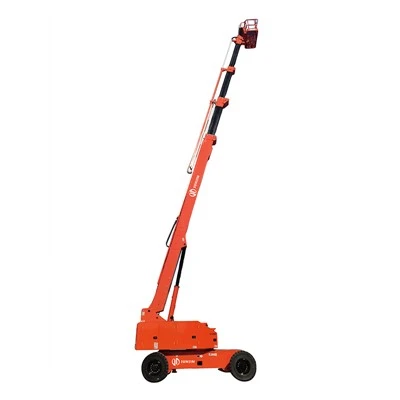
Boom lifts, which are the ones with the articulated or telescoping booms that reach up and out, have different limits too. A straight boom lift (also called a telescopic boom) is usually limited to 1:10 (10% grade) when the boom is straight, but that drops to 1:20 (5% grade) when the boom is extended outward—because the extended boom shifts the CoG forward, making the machine less stable. Articulated boom lifts, often used for jobs where you need to maneuver around obstacles, like tree trimming or building facade work, have a similar base slope limit but more sensitivity to boom position. Most articulating booms max out at 1:10 when on level ground, but if you’re lifting a load or positioning the boom at an angle, you’ll need to stay closer to 1:15 (6.7%) to avoid tipping.
Wait a second—why do I keep saying “max operating slope” instead of just “max slope”? Because there’s another critical point: you never drive an AWP up a slope while the platform is extended. That’s where a lot of job site accidents happen. Operators will extend the platform to reach a lower spot, then drive across a slope, not realizing that shifting the weight of the platform and boom is shifting the CoG. The rated slope on your AWP’s data plate is only for driving on slopes with the platform stowed and the boom in the travel position. If you extend the platform, you need to reduce your slope by half, minimum. That’s a rule I’ve been repeating to operators since my first week as a tech, and it’s the rule that prevents 90% of the slope-related near-misses I’ve seen.
Now, let’s talk about the factors that change these limits, because they’re not one-size-fits-all. First, terrain type matters. A slope that’s smooth concrete and compacted gravel is way different than a slope with loose dirt, mud, or rocks. If you’re operating on rough, uneven ground, you can’t just rely on the spec sheet number—you have to adjust. Loose ground can cause the wheels or tracks to sink a little, which changes the machine’s base and makes the effective slope steeper. Last year, we had a customer who tried to use a diesel scissor lift on a muddy 12% grade. The front wheel sank 6 inches into the mud, and the machine tipped forward, damaging the lift and luckily missing the operator. That could have been avoided if they’d either chosen a model with a higher load capacity for uneven terrain or brought in a different machine for the job.
Wind is another big factor. A lot of people forget that AWPs are tall, narrow structures, so wind acts like a big force pushing on the side. If you’re on a slope, that wind pressure makes the CoG shift even more. OSHA (the Occupational Safety and Health Administration) has rules that say if wind speeds exceed 28 mph, you have to stop operating most AWPs—especially if you’re extended. On a slope, that limit goes down to 20 mph, because the wind adds extra stress on the stability. I once had a job on a bridge project where we had to shut down for two hours because wind hit 22 mph, even though the slope was only 8% and the platform was fully stowed. It’s a pain, but it’s worth it—we didn’t want anyone getting hurt.
Also, don’t forget about load. The rated operating capacity (ROC) on your AWP’s data plate includes the operator, tools, and any materials. If you overload the platform, even on a gentle slope, you’re shifting the CoG outside the stable base. We recently had a rental customer who loaded a scissor lift with 1,200 pounds of drywall, plus two operators, when the ROC was only 1,000 pounds. They were on a 9% slope, and the machine tipped sideways, putting two workers in the hospital. It’s a simple number to check, but people skip it all the time because they’re in a hurry.
Now, how do you actually measure a slope to make sure it’s safe? You can’t just guess with your eyes—most people underestimate steep slopes. A 10% grade looks almost flat to the untrained eye. The easiest tool is a clinometer, which is a small, cheap device that attaches to the side of your AWP and tells you the slope grade. Some newer AWPs even have built-in slope sensors that alarm and shut down the machine if you exceed the limit. That’s a feature we push hard on our models, because it takes the guesswork out for operators, especially new ones. But even with a sensor, you still have to inspect the slope for soft spots, rocks, or debris that could throw off the reading.
Another common mistake I see is trying to turn on a slope. A lot of operators will drive straight up a slope, then turn at the top, thinking that’s fine. But turning on a slope shifts the weight diagonally, not just forward or backward, which is way more likely to cause a tip. You should always drive straight up and down slopes, never turn. If you need to change direction, go all the way to level ground first. That’s another rule that’s easy to break when you’re in a rush, but it’s one of the most important for stability.
Let’s get back to the supplier side of this, because that’s my world. When I talk to customers, the first thing I do isn’t just quote a price—it’s walk them through slope limits, model types, and accessories that fit their job. For example, a contractor doing interior work on flat concrete in a warehouse doesn’t need a rough-terrain AWP with a 14% slope limit. They can get a standard electric scissor lift that’s lighter, cheaper, and more maneuverable indoors. But a contractor doing roadwork on uneven, muddy shoulders? They need a rough-terrain model with larger tires, a higher slope rating, and maybe 4WD for extra traction.
We also train every operator who rents or buys from us on slope safety, because we know that even the best machine won’t be safe if the operator doesn’t know how to use it. Our training includes hands-on practice with slope tests, how to use clinometers, what to do if the slope sensor alarms, and what to do if the machine starts to tip (stay inside, don’t jump, grip the handle, lean away from the direction of the tip). We’ve had operators tell us that training is what saved them when they ran into an unexpected soft spot on a slope last year.
Wait, what about regulatory standards? I mentioned OSHA earlier, but there are other standards too, like ISO (International Organization for Standardization) and ANSI (American National Standards Institute). These standards set the minimum slope limits for AWPs, based on testing that simulates worst-case scenarios: full load, wind, rough terrain, extended booms. The specs on our machines are all certified to meet these standards, so you can trust that the number on the data plate isn’t made up—it’s been tested in a lab and on job sites for years.
A common question we get from new customers is: “What if the job site has a slope steeper than the maximum for my AWP?” The answer is simple: don’t use that AWP. We’ve had customers try to “make it work” by lowering the load or driving extra slowly, but that doesn’t change the physics. If the CoG is outside the stable base, the machine will tip, no matter how slow you go. The fix is to either bring in a larger, higher-capacity AWP with a steeper slope limit, or use a different type of access equipment—like a ladder or scaffolding—for the job. Cutting corners on access equipment never pays off in the long run.
Let me wrap this up with a few key takeaways, because this is information that could save a life. First, always check your AWP’s specific slope limit for your model, not a generic number online. Second, never drive on a slope with the platform extended—you’ll need to reduce the limit by at least half. Third, measure slopes with a clinometer or built-in sensor, don’t guess. Fourth, never overload the platform or turn on a slope. Fifth, adjust for terrain and wind—loose ground and high wind lower your effective slope limit.
At the end of the day, selling AWPs isn’t just about selling a machine that can reach high places. It’s about selling safety, reliability, and peace of mind for job sites. If you’re planning a project, whether it’s a small residential job or a large commercial construction site, take the time to get the right AWP for your slope conditions, and make sure your operators are trained on all the safety rules. If you have questions about which AWP is right for your job, or need more information about slope limits and safety, reach out to our team to discuss your specific needs. We’re here to help you get the job done safely and efficiently.
Truck Mounted Aerial Work Platform References
Occupational Safety and Health Administration. 29 CFR 1926 Subpart L.
American National Standards Institute. ANSI/SIA A92.5-2020.
International Organization for Standardization. ISO 16368:2018.
Yantai Quanrui International Trading Co., Ltd.
As one of the most reliable aerial work platform manufacturers and suppliers in China, we’re featured by high quality customized products. Please rest assured to buy discount aerial work platform made in China here from our factory. Contact us for pricelist and quotation.
Address: No. 278, Sanya Road, Gaotuan Town, Fushan District, Yantai City, Shandong Province, China
E-mail: Info@quanjin1588.com
WebSite: https://www.qr1588.com/
