If you’re in the market for a medical or healthcare power supply—whether you’re an OEM building diagnostic equipment, a clinician upgrading portable monitors, or a facility manager outfitting a hospital wing—you’ve probably heard the term “electromagnetic compatibility” (EMC) thrown around a lot. As someone who’s spent the last decade designing and supplying these exact power supplies, I can tell you EMC isn’t just a box to tick for regulatory approval; it’s the quiet backbone of patient safety. Mess with EMC, and you risk a defibrillator misfiring, a vital signs monitor glitching, or even a surgical robot veering off course. None of that’s worth the cost savings of skipping a key EMC step. Medical&Health Care Power Supply

Let me break this down straight, no industry jargon overload (I’ll explain every acronym when it first pops up) and ground this in what actually matters for our customers, not just textbook rules.
First, let’s get clear on what EMC means for medical gear specifically. EMC has two sides: electromagnetic interference (EMI) and electromagnetic susceptibility (EMS). EMI is when your power supply sends out electrical noise that messes with other devices. EMS is when your power supply gets knocked off by noise from other gear in the room. For regular consumer electronics, like a phone charger, these rules are loose—you just don’t want your Wi-Fi to cut out every time you plug in your laptop. But in healthcare? The stakes are life or death. A pacemaker, for example, is super sensitive to even tiny electrical signals, and a power supply’s stray noise could disrupt its function. Same with an MRI machine, which generates its own massive magnetic fields—your power supply has to keep working no matter how much interference is flying around.
Now, what are the actual requirements we have to follow, and why do they matter for power supplies? The big one here is IEC 60601-1-2. That’s the international standard for medical electrical equipment EMC, and it’s non-negotiable for any power supply we supply. Most countries will accept IEC 60601-1-2 as the baseline, but there are regional tweaks—like in the U.S., the FDA references this standard, and the EU requires compliance with it before you can sell gear there. If you don’t meet it, your device won’t get cleared for market, plain and simple.
Let’s dive into what IEC 60601-1-2 actually mandates for power supplies, because it’s not just one test. First, emission limits (that’s our power supply not messing with other stuff). This is split into two categories: conducted emissions and radiated emissions. Conducted emissions are the noise that travels through the power cord, so other devices plugged into the same wall outlet pick it up. Think of a portable ultrasound machine’s power supply: if its conducted emissions are too high, it could mess with the nearby EKG monitor’s readings. We test this by hooking the power supply up to a special test receiver and measuring how much noise leaks onto the line—we have to stay below 10dB for most frequency ranges, and even lower for frequencies that medical devices often use, like the ones used for wireless patient monitors. Then there’s radiated emissions: noise that travels through the air. For power supplies, this comes from switching transistors and transformers inside. We test this in an anechoic chamber (a room lined with sound-absorbing foam, but for electromagnetic waves) to make sure our power supply doesn’t emit more than 40dB above what’s allowed for medical gear. A common mistake new suppliers make is skimping on shielding inside the power supply, so instead of adding a thin metal shield, they use thicker metal that adds unnecessary weight—something you don’t want for a portable insulin pump’s power supply. That’s where our team comes in; we’ve refined our designs to hit emission limits without making the device bulky.
The other half of IEC 60601-1-2 is immunity (that’s our power supply not getting messed up by noise from others). This is way more strict than what you’d find in, say, an office power supply. Let’s take a real example: a hospital’s surgical suite has a lot of high-voltage equipment, like electrosurgical units that cut tissue with electrical sparks. Those sparks create a huge burst of electromagnetic noise. Our power supplies for surgical tools have to survive a 2kV electrical fast transient (EFT) test—meaning we pulse the power supply with a 2000V spike 5 nanoseconds long, thousands of times, and it still has to keep working. No glitching, no shutting down mid-surgery. Another common test is electrostatic discharge (ESD): when a clinician walks across a carpet and touches a metal monitor stand, that’s up to 15,000V of static. Our power supplies have to not only handle that static but also keep powering the monitor without dropping a single frame of vital signs data. We’ve seen cheap power supplies fail here all the time—they shut down when a tech bumps a monitor, which is a huge safety issue.
There’s also a thing called “mode of operation” that I want to mention, because not all medical power supplies are the same. The standard splits medical devices into two classes: non-critical and critical. Critical devices are ones where a failure could kill a patient—defibrillators, pacemakers, anesthesia machines. For these, the EMC immunity requirements are twice as high as they are for non-critical, like a diagnostic ultrasound that just gives pictures, or a patient’s room TV. We tailor every power supply we make to the mode of operation our customer needs. For example, a power supply for a portable EKG monitor (non-critical) can handle lower noise, but we still over-engineer it a bit, whereas a power supply for an emergency transport ventilator (critical) has triple-shielded cables and extra filtering to block noise from the truck’s electrical system.
Now, let’s talk about something that a lot of people don’t think about: power line characteristics. Hospitals aren’t like your home. Home outlets give you a stable 120V or 240V, 60Hz or 50Hz, no big fluctuations. Hospitals have heavy equipment that draws huge current, so the line voltage can dip, spike, or even go out for a few milliseconds. Our power supplies have to ride through that. IEC 60601-1-2 requires us to test for voltage dips up to 50% of the nominal voltage, for up to 10 cycles, and the power supply has to keep running. If it shuts down during a blackout in the ICU, that’s a disaster. We use active power factor correction (PFC) in almost all our units now, which helps smooth out line fluctuations and also reduces conducted emissions. But PFC has its own EMC hurdles—we had to tweak our switching controllers to make sure they don’t create extra noise that would interfere with wireless devices in the hospital.
Wait, what about wireless medical devices? More and more, medical gear is wireless: patient wearables that send heart rate data to a nurse’s station, portable X-ray machines that transfer images over Wi-Fi. The FCC and ETSI (European Telecommunications Standards Institute) have specific rules for wireless coexistence, which overlap with IEC 60601. Our power supplies for these wireless-enabled devices have to ensure their EMI doesn’t bleed into the 2.4GHz and 5GHz bands that Wi-Fi and Bluetooth use. A while back, we had a customer building a remote patient monitor that kept dropping Bluetooth connections—turns out their power supply’s switching frequency was right in the middle of the Bluetooth band. We re-tuned the switching circuit and added a low-pass filter, fixed the issue immediately. That’s the kind of hands-on problem-solving we do, not just checking boxes.
Let’s also clear up a myth I hear all the time: “My power supply works fine on a regular device, so it’ll work for medical.” No, that’s not true. Regular power supplies meet IEC 61000, which is for general industrial and commercial use. The EMC limits there are way looser. For example, the maximum radiated emissions for a general power supply are 50dB, but for medical, it’s 40dB. That 10dB difference might sound small, but it’s a huge gap in how much noise the power supply puts out. We had a customer who tried using an off-the-shelf power supply for their anesthesia monitor—they thought it was identical, just cheaper. It kept causing their wireless network in the OR to lag, so the doctors couldn’t pull up patient charts. They switched to our medical-grade power supply, and the issue was gone. That’s the value of getting EMC right from the start.
What about testing? It’s not just a one-and-done. We have third-party labs that do all the IEC 60601-1-2 testing, and we retest every batch of power supplies we make. But we also do internal testing on every unit before it ships—we run the ESD, EFT, and line fluctuation tests ourselves, because a lab test might be perfect, but a small component variance in a batch could throw things off. Last year, we caught a batch of power supplies where a capacitor was 10% smaller than the spec, which would have made the power supply fail the voltage dip test. We fixed it before shipping, saved our customer a lot of hassle. That’s something you won’t get from a random supplier—we pay attention to every detail.
Now, why does this matter for you, the person reading this (whether you’re a medical device engineer, a procurement manager, or a healthcare facility lead)? If you cut corners on EMC for your power supply, you’re risking:
- Regulatory delays or fines: The FDA can pull devices that don’t meet EMC standards, and the EU will block imports that don’t have CE marking for EMC.
- Safety risks: A power supply that fails immunity tests can cause a device to glitch, shut down, or give wrong readings—especially critical devices.
- Compatibility issues: Your device won’t play nice with other gear in the hospital, leading to workflow disruptions, frustrated clinicians, and even patient care delays.
And here’s the good news: when you work with us, we don’t just sell you a power supply and wash our hands of it. We’re there to help you design around EMC from the start, not retroactively patch it. We can walk you through which tests your specific device needs, tweak the power supply’s design to fit your form factor (no bulky shielding if you’re building a small wearable), and even help with third-party testing if you need it. We know that in healthcare, time is money, and patient safety is non-negotiable—so our EMC requirements are built into every power supply, not added as an afterthought.
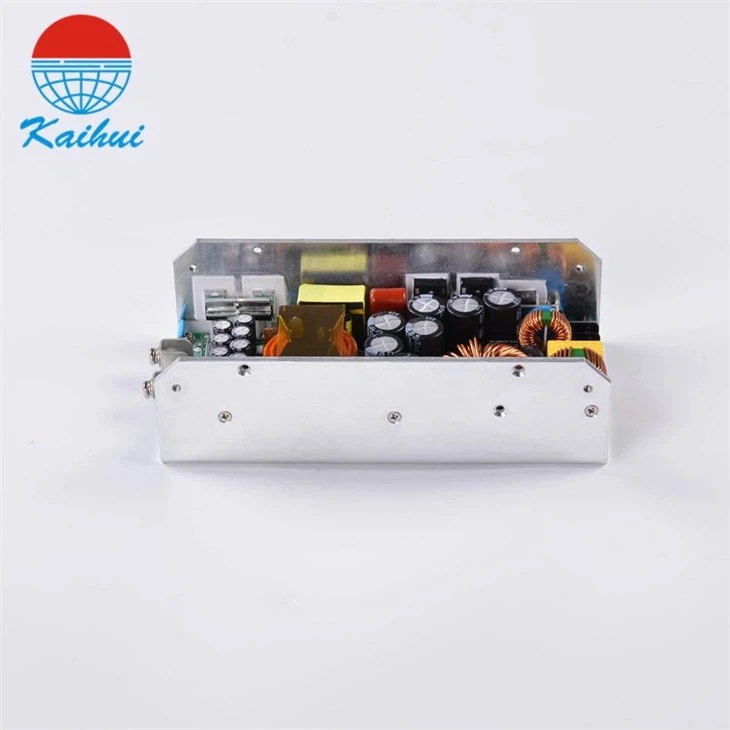
If you’re in the market for a reliable, EMC-compliant medical and healthcare power supply, and you want to make sure you’re not taking unnecessary risks with patient care or regulatory approval, reach out to our team to talk through your specific needs. We can answer questions about your device’s mode of operation, help you navigate regional EMC rules, and even share test data for previous power supplies we’ve built for similar equipment. No sales pitch, no jargon—just straight talk about making power supplies that work when it matters most.
PCB Power Supply References
IEC 60601-1-2: Medical electrical equipment – Part 1-2: General requirements for basic safety and essential performance – Collateral standard: Electromagnetic compatibility – Requirements and tests
U.S. Food and Drug Administration. (2021). Guidance for Industry: Medical Device Electromagnetic Compatibility (EMC)
European Telecommunications Standards Institute. (2020). ETSI EN 301 489-17: Electromagnetic compatibility and Radio spectrum Matters (ERM); ElectroMagnetic Compatibility (EMC) standard for radio equipment and services; Part 17: Specific conditions for 2.4 GHz wideband transmission systems and 5 GHz wideband transmission systems
Guangzhou Kaihui Electronics Co., Ltd.
Address: 2F BLDG8, Standard Ind.Park, Dongchong Town, Nansha District 511453, Guangzhou, Guangdong, China
E-mail: amy@gzkaihui.com
WebSite: https://www.kaihuipowersupply.com/
