As a supplier specializing in 630A distribution boxes, I get asked this question all the time—by electricians overseeing commercial construction projects, facility managers updating factory power systems, and even design engineers fine-tuning industrial electrical setups. A 630A distribution box isn’t just a metal cabinet with wires inside; it’s a critical piece of infrastructure that keeps high-amperage power safe, contained, and controllable for hundreds of devices. Over the years, I’ve walked clients through every safety feature we build into our 630A units, and I’ve seen firsthand how these features prevent fires, electrical shocks, and costly downtime. Let me break down exactly what makes a 630A distribution box (also called a distribution board, or DB for short) safe enough for heavy-duty use. 630A Distribution Box
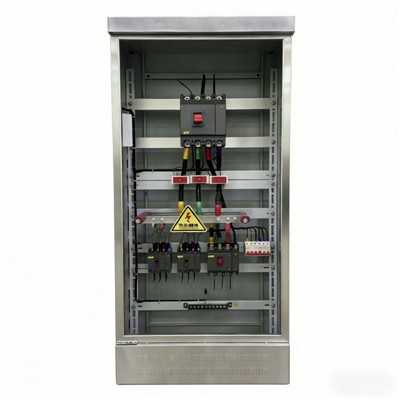
First, let’s start with the enclosure itself. When you’re dealing with 630A—enough power to run a small industrial machine, a large commercial refrigeration system, or multiple office floors—water, dust, or accidental contact with live parts can turn a routine power connection into a dangerous hazard. That’s why all our 630A distribution boxes use enclosures rated IP65 or higher. Wait, let me explain what IP65 means: the first number (6) means they’re completely dust-tight, so no debris can seep into the cabinet and cause a short circuit. The second number (5) means they’re protected against low-pressure water jets from any direction, which is perfect for outdoor installations, loading docks, or spaces where cleaning equipment might splash water nearby. I’ve seen cheaper suppliers cut corners here, using IP20 enclosures that only protect against finger contact—total non-starter for 630A. That kind of enclosure won’t hold up in a factory workshop or a construction site, where dust and splashes are constant. We also build our enclosures from heavy-gauge galvanized steel, not thin aluminum or plastic, because steel resists impact and corrosion far better. For extra safety, every enclosure has a gasket-sealed door, so the seal isn’t just around the frame—it’s continuous, which keeps moisture and debris out even if someone is adjusting the internal components.
Next, the core safety feature: overcurrent protection. A 630A distribution box is designed to split a main 630A incoming power feed into multiple outgoing circuits, each for different loads. If one of those circuits draws more current than it’s supposed to, that excess current generates heat that can melt insulation, spark, or start a fire. So we equip every unit with high-quality MCBs (Miniature Circuit Breakers) or MCCBs (Molded Case Circuit Breakers) rated for the specific circuit loads, not just generic breakers. Wait, for the main incoming feed, we always use an MCCB rated for 630A, because MCCBs handle high amperage far more reliably than standard MCBs. What makes these different? MCCBs have built-in thermal and magnetic trip mechanisms: the thermal trips handle moderate overcurrent (like a load that’s drawing 10% too much power for an hour, which would gradually overheat wires) by bending a bimetallic strip to cut power. The magnetic trips kick in instantly for short circuits—when a hot wire touches a neutral or ground, creating a massive, sudden current surge that could arc through the cabinet in milliseconds. I’ve had a client tell me a cheap distributor swapped in a standard 630A switch instead of an MCCB, and their warehouse caught fire when a forklift shorted a circuit. That switch just would have melted, not cut power. Our units don’t do that—every overcurrent device is tested to UL or IEC standards, so you know it will trip when it’s supposed to, no exceptions.
Then there’s arc fault protection. This is a feature that a lot of people overlook, but it’s one of the biggest safety wins for high-amperage distribution boxes. An arc fault happens when a loose wire, damaged insulation, or corroded connection creates a small, continuous spark (arc) inside the box. For 630A systems, these arcs can reach temperatures of 35,000°F—hotter than the surface of the sun—enough to melt steel, ignite adjacent wiring, and even blow the door off the cabinet. That’s called an arc flash, and it’s one of the leading causes of electrical injuries in commercial and industrial settings. Our 630A distribution boxes are equipped with arc fault detection devices (AFDDs) that monitor the electrical current for the unique signature of a spark arc. When they detect one, they trip the circuit in less than a millisecond—way faster than a standard breaker. We also design the internal layout to prevent arcs from spreading in the first place: we separate incoming and outgoing busbars with rigid plastic barriers, so a spark on one set of bars can’t jump to the other. Busbars are the thick copper strips that carry power around the box, right? Those barriers are non-conductive, heat-resistant, and molded to fit perfectly, so there’s no gap for an arc to bridge. Some suppliers leave that out to cut costs, but for a 630A box, that gap is a death trap. I’ve had clients come to us after a power outage, and they say their old distributor’s box had an arc flash that blew the door off—they never even knew that feature was missing until we showed them.
Grounding and bonding are non-negotiable for a 630A distribution box, too. Grounding is the process of connecting all non-live metal parts of the system to the earth, so if a live wire touches a metal cabinet, the current flows to the ground instead of through someone touching the cabinet. Bonding is connecting all those metal parts together, so they all stay at the same electrical potential and don’t create a shock risk. Our 630A distribution boxes have a dedicated, oversized grounding busbar that’s large enough to handle the full 630A load, not a tiny strip that can’t carry the current. We also include copper bonding straps that connect the enclosure door to the cabinet frame—so even if the door has a plastic coating or a paint layer (which can be non-conductive), the strap creates a direct metal connection. A lot of cheaper boxes skip the door strap, so if someone touches the door while a live wire is loose inside, they’ll get a shock. We test every unit for continuity of the grounding and bonding circuit with a milli-ohmmeter, to make sure there’s no hidden resistance that would prevent current from flowing to the ground fast enough. That test isn’t just a formality—it’s what stops a 630A system from turning a minor electrical fault into a fatal shock.
Another safety feature we prioritize is clear labeling and easy operation. Let’s be honest: if a facility manager or electrician can’t tell which circuit corresponds to which piece of equipment, they’ll either shut down the wrong circuit during maintenance, or leave a live circuit exposed when they need to work on it. Our 630A distribution boxes have durable, laser-etched labels on every circuit breaker, right on the front of the door, so they don’t peel off after a few years of being in a dusty factory or a busy office. We also include a circuit directory inside the door, so users can map out all the connections before they open the box. The main incoming switch and the MCCBs are designed with large, tactile handles, so someone can operate them even if they’re wearing work gloves, which is standard in industrial settings. We also add a lockable door latch to every unit, so you can padlock the box to prevent unauthorized access—like a kid or a maintenance worker flipping a breaker by accident, or a thief tampering with the internal components. I’ve heard too many stories of companies that had to close for a day because a worker accidentally turned off the wrong circuit, or someone got a shock because they could reach into the box without permission. That lockable latch prevents both.
Thermal monitoring is a newer feature we’ve added to our 630A distribution boxes, and it’s been a game-changer for predictive maintenance. High-amperage systems generate heat, and loose connections, overloaded circuits, or damaged busbars can cause hot spots that go undetected until they cause a fire. Our units have small, non-contact temperature sensors mounted on the busbars and main breakers, which send real-time temperature data to a local display or a building management system (BMS). If a hot spot reaches a pre-set threshold (usually around 140°F, which is where wiring insulation starts to degrade), the sensor sends an alert to the facility manager, so they can fix the issue before it becomes a hazard. This isn’t a standard feature on cheaper 630A boxes—most suppliers don’t include thermal monitoring because it adds a bit of cost, but it saves our customers thousands in downtime and fire damage. We worked with a local manufacturing plant last year that had a hot spot on their old distribution box, and the sensor on our new unit alerted their team right away. They tightened the connection in 10 minutes, instead of having to shut down their assembly line for 8 hours to repair a fire that almost happened.
Now, let’s talk about installation safety, because a distribution box is only as safe as its installation. We don’t just sell a box and walk away—we provide detailed, step-by-step installation guides that comply with NEC (National Electrical Code) and IEC standards, which outline exactly how to wire a 630A box to prevent hazards. For example, the NEC requires that incoming cables to a 630A box have a minimum wire gauge to handle the current—too thin, and the wire will overheat. Our guides specify the exact gauge, and we even include cable clamp kits that hold the incoming and outgoing wires securely, so they don’t pull loose over time. Loose wires are one of the top causes of arc faults, so those clamps are non-negotiable. We also offer pre-wiring services for clients who don’t have the in-house expertise to wire a heavy-duty 630A box, so we can make sure every connection is tight, every busbar is properly torqued, and every safety feature is active before the box leaves our facility.

I know this might sound like a sales pitch, but every feature I’ve outlined here is something I’ve had to explain to a client at some point, after they had a bad experience with a low-quality distribution box. When you’re dealing with 630A power, cutting corners on safety isn’t just a cost issue—it’s a risk to lives, equipment, and your business. Our 630A distribution boxes are built with every one of these features tested and verified, because we’ve seen what happens when safety is an afterthought. If you’re a project manager, electrician, or facility engineer looking for a reliable, safe 630A distribution box for your next project, I’d be happy to walk you through our units in more detail, answer any questions you have, and help you find the right solution for your power needs. Don’t wait until a hazard becomes a disaster—reach out to discuss your requirements, and let’s make sure your power distribution is as safe as it can be.
By Mounting Method References
- National Electrical Code (NEC) 2023, Article 409: Industrial Control Panels and Distribution Boards
- International Electrotechnical Commission (IEC) 60439-1: Low-voltage switchgear and controlgear assemblies – Part 1: General rules
- Occupational Safety and Health Administration (OSHA) Electrical Safety Standards, 29 CFR 1910 Subpart S
- Underwriters Laboratories (UL) 67: Standard for Safety for Switchboards, Switchgear, and Substations
Apeks Electric Co., Ltd.
As one of the leading 630a distribution box manufacturers and suppliers in China, we also support custom service. With abundant experience, we warmly welcome you to wholesale high quality 630a distribution box from our factory. Welcome to view our website for more information.
Address: No.2 Yuyao Rd, Yuxin, Nanhu District, Jiaxing, China
E-mail: kevin@apekselectric.com
WebSite: https://www.powerdistros.com/
